
Most deal teams already have some AI in the workflow. Someone drafts a memo section with it, asks it to summarize a call transcript, or points it at a filing when a question comes up. That’s useful, and it’s also the first and easiest stage of AI adoption: a copilot. It waits for you.
You still have to know what to ask, when to ask it, and how to stitch three separate outputs into one coherent view of a deal.
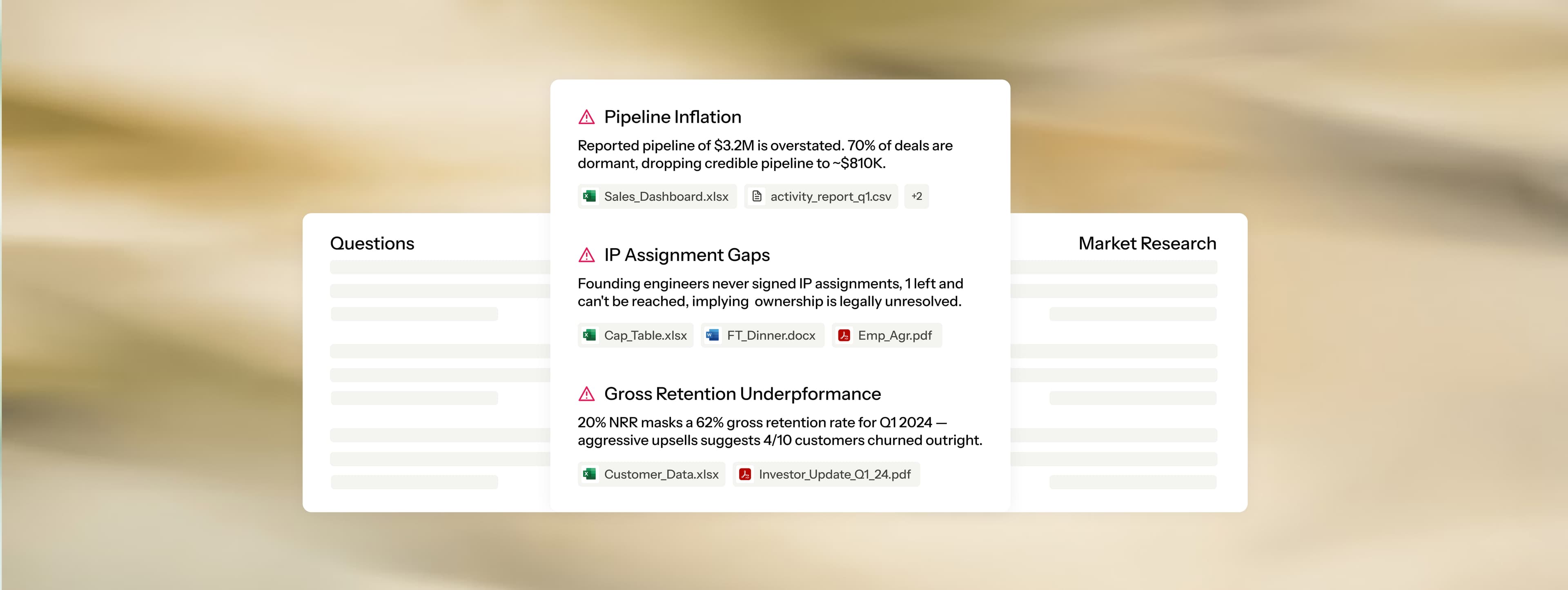
The next stage looks different. Instead of answering the question you asked, the system notices the thing worth flagging before you thought to ask: a portfolio company’s filing changes, a competitor makes a move, a data point in the model stops reconciling. It surfaces that on its own. That’s the shift from a copilot to something closer to an agent — proactive instead of reactive, working across a sequence of steps instead of one prompt at a time.
Two ways to put AI on a deal team
- Answers the question you thought to ask
- One prompt, one output, one tool at a time
- Every handoff between systems runs through a person
- You remember what to check and when to check it
- Fast at the task in front of it; blind to the rest
- Surfaces what changed before you asked about it
- Carries a sequence of steps through one workflow
- Reaches across systems without a manual handoff
- Notices the stale comp set, the number that stops reconciling
- Scope, not speed, is what actually changes
Where copilots stop
A copilot is fast at the task in front of it. Its limitation is scope, not speed. Every handoff between tools still runs through a person: pull the filing, drop it into the model, remember to check whether the comp set is stale, remember to ask about the thing the CIM glossed over. The tool is capable; the orchestration is still manual.
Why most firms stall before they scale it
Plenty of firms are experimenting with more autonomous, workflow-level AI. Far fewer have gotten it running end-to-end without a person babysitting every step. Usually the gap traces back to the data underneath the model, not the model itself. An agent that’s supposed to act across systems needs those systems to agree with each other first.
Firms that get further tend to have done the less glamorous work earlier: getting the dataroom, the CRM, and the firm’s own knowledge base into a state where a system can reason over all of it without a person reconciling the differences by hand.
Where we are, and where we’re not pretending to be
Today, Deep Research and our QoE tooling behave like a strong copilot: point them at a dataroom, and they draft a cited memo section, a working model, or a set of QoE adjustments, with the sourcing shown rather than asserted. You still direct the next step. That’s deliberate. We treat an unsourced claim as a defect, not a shortcut, and generation is non-deterministic enough that we don’t make a quality claim off a single run.
The direction we’re building toward — an orchestration layer that carries research, modeling, and memo drafting through one continuous workflow instead of three separate requests — is real, but it’s early: in design and prototype, not in front of customers yet. We’d rather say that plainly than round it up.
The honest version
This is analyst-augmentation, not analyst-replacement, at every stage described above.
What’s interesting about the copilot-to-agent shift is that the system now surfaces things you’d otherwise have to remember to ask for. If you want to see where our workflow sits on that spectrum today, and where it’s headed next, we’re happy to walk through it.