
Every AI due diligence tool claims to be accurate. None of them can prove it, at least not in the way that matters to a PE analyst who has to defend a number to an IC.
Ask a typical AI model to pull EBITDA from a CIM and it will give you a number, confidently, in a clean sentence. What it won’t give you, unless you go dig for it yourself, is the page it came from, the exact line item, or a way to check whether it paraphrased, rounded, or quietly hallucinated. You’re left trusting a black box on the exact task where trust has to be earned line by line.
That’s not a minor UX gap. In diligence, a wrong number isn’t just a wrong number. It’s a wrong number that makes it into a model, into an IC memo, and eventually into a valuation someone signs their name to.
“Mostly right” is not a diligence standard. It’s a liability.
Can AI do math yet?
Sort of, and that “sort of” is the whole problem. Large language models are pattern generators, not calculators. They are very good at sounding right. They are not, by default, good at being exactly right, especially with financial data that has to reconcile to the decimal.
The honest answer: AI can do math when it isn’t actually doing the math itself. That means extracting a verified figure from a source document and handing the arithmetic to a deterministic engine, not generating a plausible-looking number from a model’s internal sense of what numbers “usually” look like.
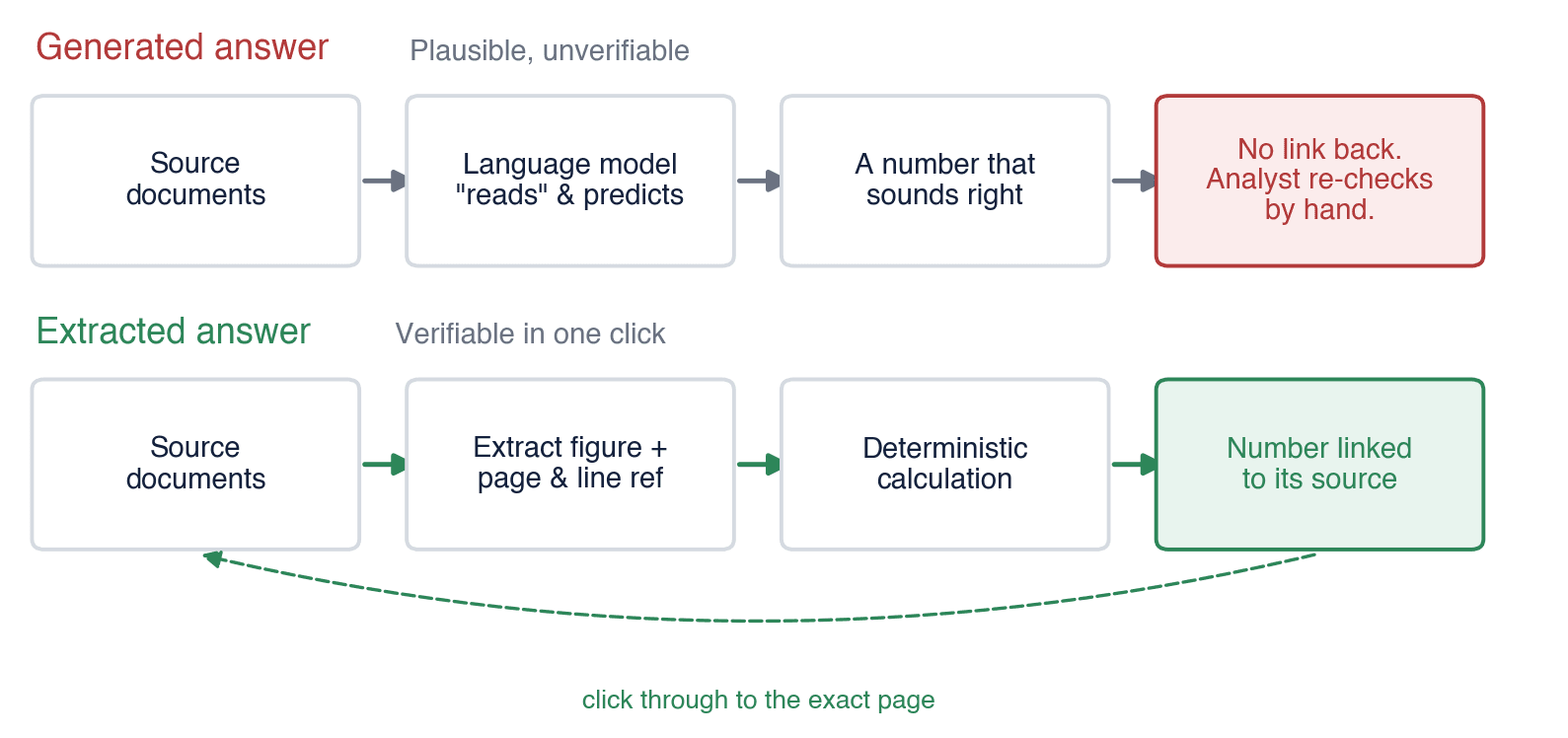
That distinction, extraction versus generation, is the difference between a tool you can defend to an IC and one you can’t.
Why we built sourcing in, not bolted on
At Acephalt, every figure our platform surfaces traces back to the exact document, page, and line it came from. It’s not a citation added after the fact for reassurance. It’s a direct link between the number in your model and the number in the source material, so you can click through and check it yourself before it ever reaches an IC memo.
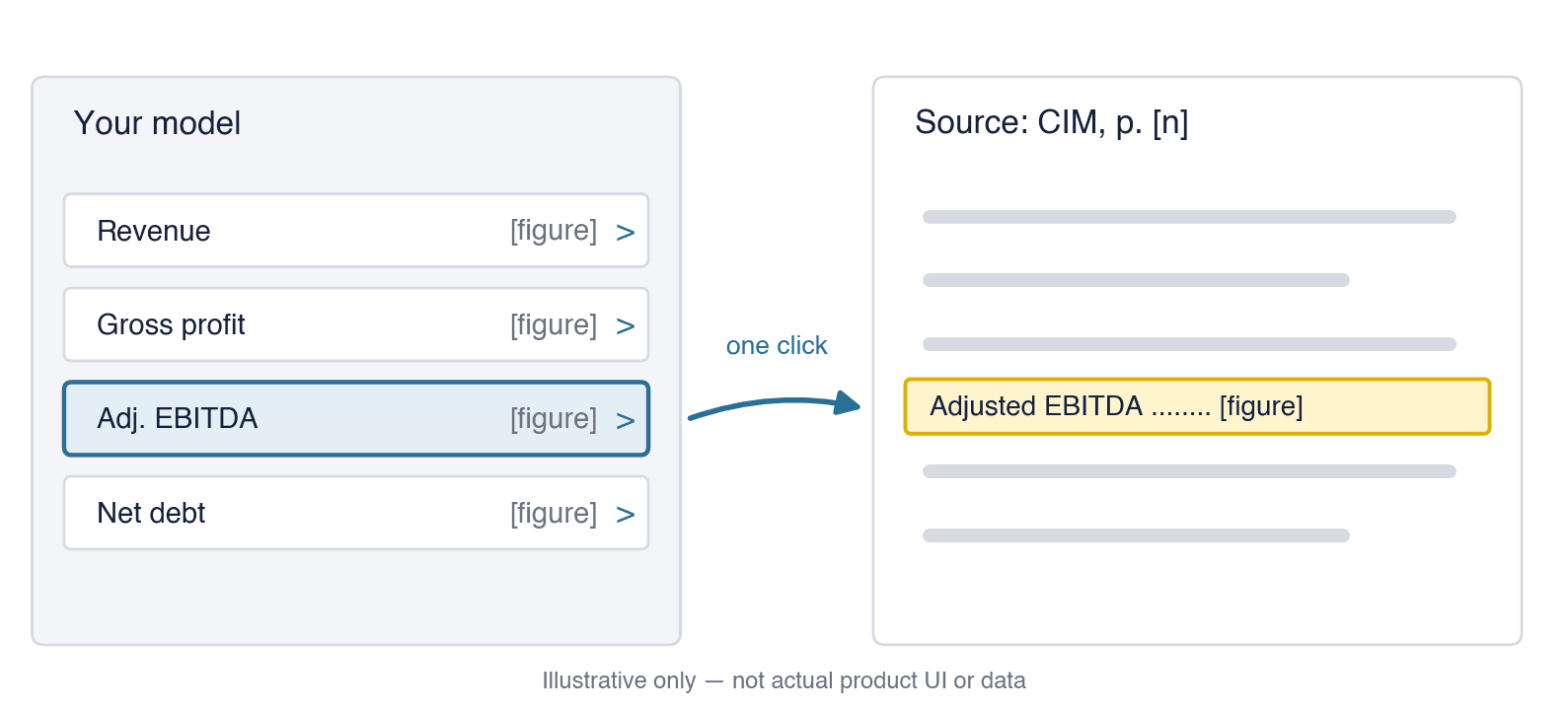
That’s a deliberate design choice, not a feature checkbox. It means:
- No number without a source. If we can’t point to where it came from, we don’t surface it.
- No hallucinated figures. The platform isn’t generating financial data from a language model’s guess. It extracts and verifies against the underlying document.
- No trust required. You don’t have to take our word for it. You check the source yourself, in seconds, because the link is already there.
| Typical AI answer | Acephalt | |
|---|---|---|
| Where the number comes from | Predicted by a language model | Extracted from the source document |
| Can you see the source? | Rarely, or after the fact | Yes: document, page, and line |
| How is the math done? | Inside the model | Deterministic calculation engine |
| Who verifies it? | The analyst, by hand | Anyone, in one click |
| IC-defensible? | Only after re-checking | Yes, the audit trail is built in |
For a boutique deal team, this matters more, not less. You don’t have a twelve-person associate bench to re-verify every AI-generated number by hand. The tool has to be trustworthy by default, because you don’t have the headcount to be the backstop.
The real question isn’t “is AI accurate enough?”
It’s “can you prove it, fast, to someone who’s going to push back?” A partner reviewing your model won’t accept “the AI said so.” They’ll ask where the number came from, and if the honest answer is “I’d have to go check,” you’ve already lost the time the AI was supposed to save you.
Sourcing isn’t a nice-to-have layered on top of accuracy. It’s how accuracy gets proven, deal after deal, without anyone having to just trust the black box.